
Wire Rope Slings




Wire Rope Slings for Heavy-Duty Lifting
Wire rope slings provide the strength, abrasion resistance, and durability needed for demanding lifting and material-handling applications. Stronger and more durable than nylon and polyester synthetic slings but more economical than chain slings, they can safely handle your load in demanding conditions and high temperatures without breaking your budget.
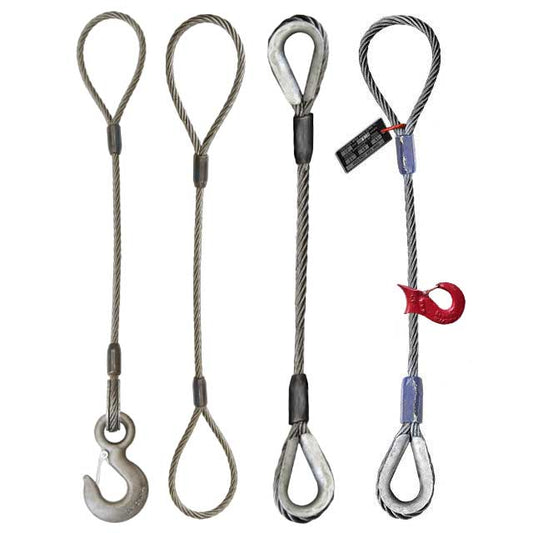
US Cargo Control offers single-leg, multi-leg bridle, braided, endless, cable laid, sliding choker, and socket-style slings. Choose a standard wire rope sling or request a custom configuration based on your required length, diameter, capacity, hitch, and end fittings.
Wire rope slings are also commonly called cable slings, steel cable slings, lifting cables, or wire slings. Regardless of the name, the sling must be selected according to its rated capacity, construction, hitch type, sling angle, load shape, and operating environment.
Wire Rope Construction
Wire rope slings are generally manufactured using either 6x19 or 6x36 EIPS IWRC wire rope that's versatile enough for most lifting jobs.
EIPS stands for Extra Improved Plow Steel, which has a tensile strength of around 10% greater than an IPS grade, so the same rope diameter has a higher lifting capacity.
Our steel wire rope slings are made with an Independent Wire Rope Core (IWRC) for the ultimate in strength and durability. It's made from steel and can be used in temperatures from -40°F / -40°C to 400°F / 204°C. This core is also resistant to crushing, so it's safer in more demanding environments.

Wire Rope Sling Classifications
6x19 and 6x36 are wire rope classes and are a nominal indicator of the wire rope's construction. The first number represents the number of strands wrapped around the wire rope's core, while the second number is an estimation of the number of wires making up each strand.
Using the table below, you can see that a 6x19 class wire rope has 6 outer strands, and the number of wires making up each strand can range from 15-26.
| Class | Outer Strands | Wires Per Strand |
|---|---|---|
| 6x19 | 6 | 15-26 |
| 6x36 | 6 | 27-49 |
Generally, wire rope slings with a diameter larger than 1" will be 6x36, while those 1" or smaller will be 6x19 for ease of construction.
So what does this mean for you? For most users, either steel cable sling configuration should work for their job. However, if you are looking for extra flexibility and fatigue-resistance in a smaller diameter or added abrasion-resistance in a larger diameter, contact us to learn more about your options!
For extreme flexibility in specialized applications, check out our cable laid slings. Manufactured using a 7x7x7 galvanized wire rope (composed of 7 strands of 7x7 cables), they bend easily and offer superior resistance to kinking.
Wire Sling Rope Eyes
The end fitting determines how the sling connects to the load and lifting device. We carry a number of options to fit different applications:
- Soft eyes: Formed wire rope eyes without a thimble
- Thimble eyes: Reinforced eyes that help maintain shape and reduce wear
- Hooks: Provide a direct connection to approved lifting points
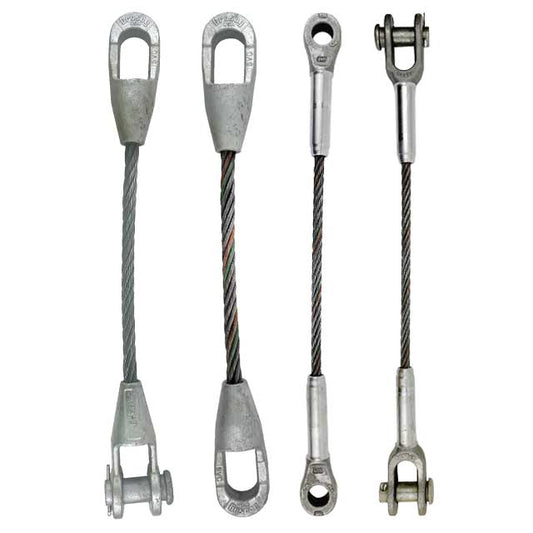
- Swage sockets: Mechanically attached socket terminations
- Spelter sockets: Socket terminations secured through a poured connection process
- Master links: Gather multiple sling legs into one connection for the crane or hoist hook
Most of the eye loops on our sling cables are created with a Flemish splice. This eye design makes the most out of the rope's capacity. The Flemish splice is a mechanical splice where the rope cable is separated into two parts (one part has three strands, the other part has the remaining three strands plus the core), then re-laid back in the opposite direction to form the loop. The ends are then secured with a carbon steel sleeve around the entire area.
Make sure every fitting is compatible with the wire rope sling and seats correctly without pinching, binding, or point loading.
Shop Wire Rope Slings by Configuration
The right sling configuration depends on the load, number of lifting points, required control, available headroom, and connection hardware. Our selection includes standard and specialized designs for a wide range of lifting applications.
- Single-leg wire rope slings: Versatile lifting cables for vertical, basket, and approved choker-hitch applications
- Wire rope bridle slings: Two-, three-, and four-leg assemblies for loads with multiple lifting points
- Braided wire rope slings: Flexible, high-capacity slings that can conform closely around a load
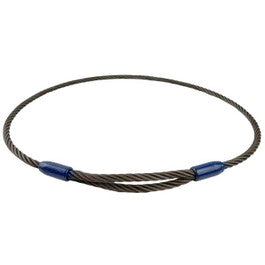
- Endless wire rope grommets: Continuous-loop slings for low-headroom and heavy-lifting applications
- Socket wire rope slings: Slings fitted with swage or spelter sockets for specialized connections
- Cable laid slings: Flexible lifting slings made from multiple wire ropes laid together
- Custom wire slings: Made-to-order assemblies built for specific lengths, fittings, and applications
Single Leg Lifting Cables
Sometimes called eye & eye slings because the most popular style has an oval "eye" at each end, these one leg cable slings are rugged, reliable, and a very popular choice among wire slings. Most can be used in all three hitches - vertical, basket, and choker.
Single leg cable slings are available in a variety of styles: Eye & Thimble, Thimble & Thimble, Eye & Hook, Eye & Eye, Sliding Choker, Spelter Socket, Swage Socket, and Cable Laid.
Wire Rope Bridle Slings
Bridle wire rope slings allow for improved balance and load control. Their design includes protective thimbles to reduce rope wear and extend sling life.
With each additional leg, you'll have improved stability and load distribution, but you'll want to balance that with the added setup complexity and the lower maneuverability.
Wire Rope Grommets
If you are working in a low headroom application, wire rope grommets have an endless design that requires less space for lifting or rigging.
Braided Wire Rope Slings
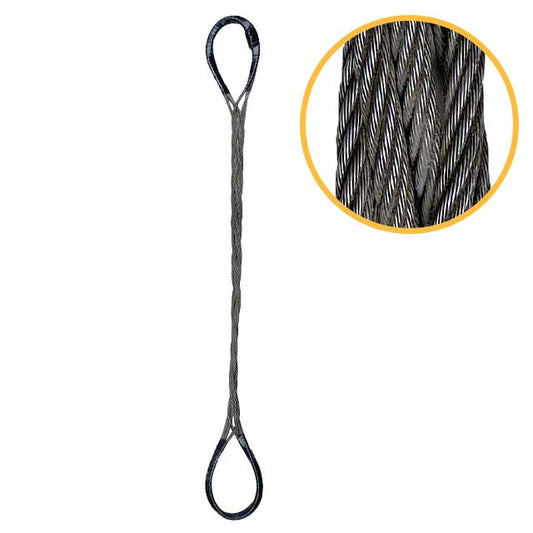
Braided wire rope slings are formed when multiple ropes are braided continuously to form the body of the sling and the eye/eyes into a single fabricated sling. They are excellent for higher capacity lifts, and can conform snugly to a load that's in a choker hitch. Because of the braided design, they also are more resistant to kinking.
Our braided wire rope slings are made in the USA and available in a variety of configurations, including a 3-part braid, 6-part braid, 8-part braid, and 9-part braid.

Custom Wire Rope Slings
If you need a unique solution for your application, request a custom wire rope sling - you can either fill out our online form or get in touch with our sales team. You'll be able to specify construction, length, end fitting, and more!
How to Choose a Wire Rope Sling
1. Determine the Load Weight
Know the total weight of the load before selecting a sling. Do not estimate when accurate weight information is available.
2. Identify the Center of Gravity
The lifting points and sling configuration must keep the center of gravity below the lifting point and maintain control throughout the lift. Loads with an offset center of gravity may place unequal forces on the sling legs.
3. Choose the Hitch
Wire rope slings may be rated differently for vertical, basket, and choker hitches. Select the sling using the rated capacity for the actual hitch being used.
- Vertical hitch: One sling connects the lifting device directly to the load.
- Basket hitch: The sling passes under the load, with both ends connected above it.
- Choker hitch: One end of the sling passes through the other eye or fitting to tighten around the load.
4. Account for Sling Angle
As the horizontal sling angle decreases, tension on each sling leg increases. Use the manufacturer’s rated-capacity tables for the applicable angle.
Do not assume that adding sling legs increases capacity or that each leg carries an equal portion of the load.
5. Check the Bend Diameter
A wire rope loses capacity when bent sharply around a small hook, pin, or load. Compare the diameter of the object supporting the rope with the wire rope diameter and consult the manufacturer when the bend is tighter than the rated conditions.
6. Evaluate the Environment
Consider heat, chemicals, moisture, corrosion, sharp edges, abrasion, and other conditions that could damage the sling. Contact the manufacturer before using a sling in chemically active environments or outside its rated temperature range.
7. Select Compatible Hardware
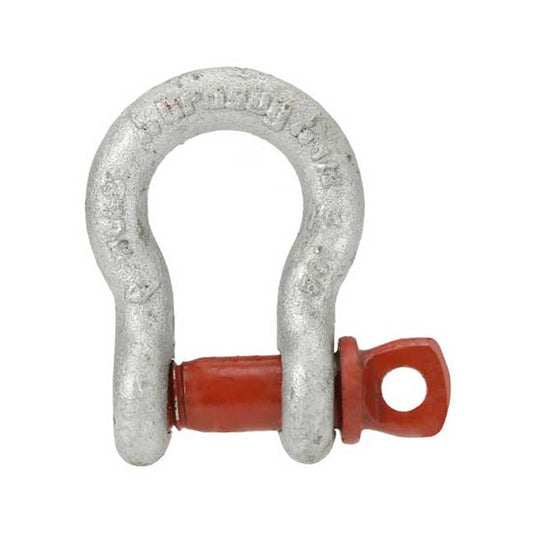
Check the size and rated capacity of hooks, shackles, master links, lifting beams, and attachment points. The lifting system is limited by its lowest-rated component.
Import vs. Domestic Lifting Slings
We offer a wide selection of both import and domestic wire rope slings, so it's simple to find the right fit for your application. Regardless of the source, all of our wire rope slings meet the requirements laid out by ASME B30.9.
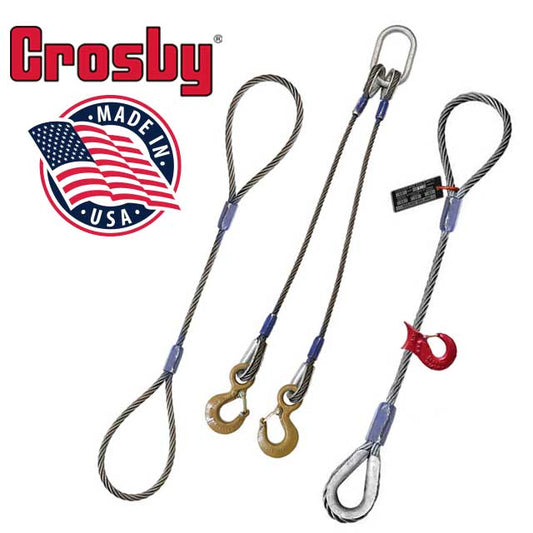
Our domestic slings are made in the USA with quality components from leading companies like Crosby.
Import slings are a more cost-effective choice, with even more styles to choose from.
Calculating the Length of a Wire Rope Sling
Wire rope sling length is generally measured between the load-bearing points of the end fittings rather than from the extreme outside ends.
- Single-leg slings: Measure from the load-bearing point of one eye or fitting to the load-bearing point at the opposite end.
- Multi-leg slings: Measure each leg from the load-bearing point of the master link to the load-bearing point of the lower fitting.

Wire Rope Sling Protection
"Slings in contact with edges, corners, protrusions, or abrasive surfaces shall be protected...to prevent damage." - ASME B30.9 (2021) 9-5.10.4(d)
Wire rope slings must be protected anywhere they contact sharp edges, corners, protrusions, or abrasive surfaces. Without suitable protection, the load can cut, crush, scrape, or permanently deform the rope.
We carry a number of sling protection options that are compatible with wire rope slings - browse our selection today!
Proof Testing & Sling Identification
Wire rope slings should have durable identification showing the manufacturer, sling size or diameter, and rated capacities for the applicable hitches and angles.
Proof-testing requirements depend on the sling configuration, end attachments, applicable regulations, manufacturer instructions, and customer purchasing specifications. Certain socket, grommet, endless, and welded-end configurations require proof testing before initial use.
Proof-test certificates are available for qualifying US Cargo Control wire rope slings when requested during ordering. Confirm documentation requirements before the sling is manufactured.
Wire Rope Sling FAQs
Q: What is a wire rope sling?
A: A wire rope sling is a lifting assembly made from steel wire rope with eyes, hooks, sockets, links, or other end fittings. It connects a load to a crane, hoist, lifting beam, or other material-handling device.
Q: Is a cable sling the same as a wire rope sling?
A: The terms are often used interchangeably in general searches and conversation. In professional rigging, wire rope sling is the more precise term for a rated lifting sling fabricated from wire rope.
Q: What are wire rope slings used for?
A: Wire rope slings are used to lift machinery, structural steel, fabricated components, construction materials, industrial equipment, and other heavy loads. The correct sling depends on the load, hitch, capacity, angle, and environment.
Q: What is the difference between 6x19 and 6x36 wire rope?
A: Both classes typically have six outer strands. A 6x36 class rope contains more individual wires and generally provides greater flexibility and fatigue resistance. A 6x19 class rope generally provides stronger abrasion resistance with less flexibility.
Q: Can wire rope slings be used in a choker hitch?
A: Many wire rope slings can be used in a choker hitch when permitted by the manufacturer. Choker capacity can be reduced by the choke angle, load diameter, and sling construction.
Q: How often should a wire rope sling be inspected?
A: A qualified person should inspect the sling and attachments before use. Periodic inspections are also required at intervals based on service conditions, frequency of use, and the nature of the lifts.
Q: Can damaged wire rope be repaired?
A: The wire rope body of a sling should not be repaired. Certain end fittings may be repaired or replaced by the manufacturer or another qualified entity, followed by any required testing and identification.
Q: Can US Cargo Control make custom lifting cables?
A: Yes. Custom wire rope slings can be manufactured with specified lengths, diameters, sling configurations, eyes, hooks, sockets, master links, and other fittings.
Need Help Choosing a Wire Rope Sling?
Choosing a wire rope sling requires accurate information about the load, hitch, sling angle, lifting points, environment, and required capacity. Contact a US Cargo Control product expert for help comparing standard and custom slings.
Complete your lifting setup with compatible shackles, rigging hooks, lifting beams, sling protection, and other rigging hardware.